lunes, 23 de noviembre de 2015

CELL CYCLE AND DEVELOPMENT. Part II: MEIOSIS


As we have seen, the cells reproduce asexually, making copies of themselves through the process called MITOSIS. With this process, from each individual cell we get two identical cells, with the same number of chromosomes (equal to the mother cell).

But there is a special type of cells that are created through a special type of process called MEIOSIS. These cells are the gametes: egg cells and sperm cells. The main differences between mitosis and meiosis are that, first, in mitosis you end up with 2 daughter cells, in meiosis you get 4. And in second place, in mitosis the cells have the same amount of chromosomes as the mother cell, but in meiosis they have half the number of chromosomes.


Como hemos visto, las celulas se reproducen asexualmente, haciendo copias de si mismas por un proceso llamado MITOSIS. Con este proceso, de cada celula individual obtenemos dos celulas hija identicas, con el mismo numero de cromosomas (e igual que el de la celula madre).

Pero hay un tipo especial de celulas que son creadas por un tipo especial de proceso llamado MEIOSIS. Estas celulas son los gametos: ovulos y espermatozoides. Las principales diferencias entre mitosis y meiosis son que, en primer lugar, en la mitosis acabamos con 2 celulas hijas, y en meiosis obtenemos 4. Y en segundo lugar, en la mitosis las celulas hijas tienen la misma cantidad de cromosomas que la celula madre, pero en la meiosis tienen la mitad del numero de cromosomas.

The gametes produced by meiosis come from a pre-existing cell that undergoes two division cycles. As the final cells have half the amount of chromosomes, they are said to be haploid cells (instead of diploid cells).

Los gametos producidos por meiosis proceden de una célula pre-exitente que sufre dos ciclos de división. Al final las células tienen la mitad del número de cromosomas, se dice que son células haploides (en vez de diploides).


Some exercises to practice in English:

Meiosis coloring

Phases Meiosis

Meiosis crossword

Comparing Mitosis vs Meiosis


Algunos ejercicios en español:

Fases Meio

Comparando Mitosis/Meiosis

domingo, 8 de noviembre de 2015

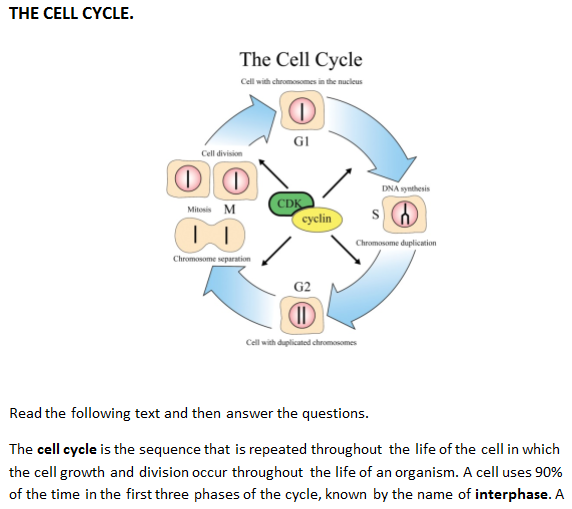
Unit 6- CELL CYCLE AND DEVELOPMENT. Part I - Cell cyle and Mitosis


During this unit we are going to cover the cell cycle. As you remember the cell is the unit of life, so it is a living organism that is born, grows, develops, eventually reproduces and at a certain moment, dies. 


Durante esta unidad vamos a cubrir el ciclo celular. Como recordareis, la célula es la unidad de vida, así que es un ser vivo que nace, crece, se desarrolla, se reproduce y en cierto momento, muere.


The cells in our bodies reproduce for two reasons: for our own growth and to repair tissues. These are the reasons why the cells reproduce asexually, making copies of themselves, undergoing mitosis.


Las células en nuestros cuerpo se reproducen por dos razones: para nuestro propio crecimiento y para reparar tejidos. Estas son las razones por las que las células se reproducen asexualmente, haciendo copias de si mismas, entrando en la mitosis.


In the human body there are specific cells which are created by a specific process called meiosis: the gametes. At the end of this process from each pre-gametic cell we get four cells with half the number of chromosomes (compared with the rest of the cells in our bodies).

En el cuerpo humano hay células especificas que son creadas por un proceso especifico llamado meiosis: los gametos. Al final de este proceso desde cada célula pre-gametica obtenemos cuatro células con la mitad de cromosomas (comparadas con el resto de células de nuestro cuerpo).


You can find the GOALS for this unit here: http://1drv.ms/1XYIskK


Summary in English: Cell cycle


Resumen en Español: Ciclo celular


EXERCISES

The first exercise we are going to cover is a reading exercise about the Cell Cycle:http://1drv.ms/1Qo9Lmz


La versión en español la podéis encontrar aquí: http://1drv.ms/20FDJ9W


Let's practice some exercises about the MITOSIS phases!

- A basic exercise with different parts and images: http://1drv.ms/1MSXfvJ

- La versión en español: http://1drv.ms/1MSXwyP


- Another exercise with pictures of all the phases, and then a matching exercise:http://1drv.ms/1MSXIxQ


This is the foldable that has all the cell cycle phases: outside we have all the steps of interphase and mitosis, inside we have the whole cell cycle .We can complete it writing in each label a brief explanation of the picture.


One of my students, Jerry Guillen, has created this video with play-doh:


And here I show you the best video I´ve found in youtube: 


domingo, 25 de octubre de 2015

UNIT 5- PHOTOSYNTHESIS AND CELL RESPIRATION (FOTOSÍNTESIS Y RESPIRACIÓN CELULAR)

Some organisms, like plants and some algae, are able to develop photosynthesis: a process to produce food as carbohydrates (sugars) using water, carbon dioxide from the atmosphere and sunlight as the energy source. This reaction takes place in the chloroplasts of the plant cells, and produce sugars as well as oxygen that is released to the atmosphere.

Algunos organismos, como las plantas y algunas algas, son capaces de realizar la fotosíntesis: un proceso para producir alimento como carbohidratos (azúcares) usando agua, dióxido de carbono de la atmósfera y luz del sol como fuente de energía. Esta reacción tiene lugar en los cloroplastos de las células vegetales, y produce azúcares y oxígeno que es liberado a la atmósfera.


There is a process that we can say is "opposite" to the photosynthesis: the cell respiration. This process takes place in the mitochondria of eukaryote cells (animals and plants), and using glucose and oxygen as reactants, produces water, carbon dioxide and energy as ATP. So this is the most important source of energy in cells.

Hay un proceso que podemos decir que es "contrario" a la fotosíntesis: la respiración celular. Este proceso tiene lugar en la mitocondria de las células eucariotas (animales y plantas), y usando glucosa y oxígeno como reactivos produce agua, dióxido de carbono y energía como ATP. Así que esta es la fuente más importante de energía en las células.


Summary in English:Photosynthesis and Respiration

Resumen en Español:Fotosíntesis y Respiración

domingo, 18 de octubre de 2015

UNIT 4- CELL TRANSPORT (TRANSPORTE CELULAR)

As we have seen, cells are living entities, so they need certain substances to survive (as oxygen, water, food...) and during their functions they produce wastes they have to rid of because if they stay inside them, they could be toxic, like the carbon dioxide. All this gases and particles come in and out of the cell through the plasma membrane, which main function is to control what goes in and out of the cell:

Como hemos visto, las células son entidades vivas, así que necesitan ciertas sustancias para sobrevivir (como oxígeno, agua, comida...) y durante sus funciones producen desechos de los que se tienen que desacer porque si se quedan dentro de ellas pueden ser tóxicos, como el dóxido de carbono. Todos estos gases y partículas entran y salen de la célula a través de la membrana plasmática, cuya función principal es controlar lo que entra y sale de la célula:


Not all the substances pass the membrane the same way, it depends on their size and nature. Some of them can pass directly though the lipid bilayer without needing energy, like the oxygen and carbon dioxide, through the process called DIFFUSION: moving from the higher concentration to the lower concentration. When the substance moving through the membrane is the water, we call it OSMOSIS. And some molecules are too big to pass through the bilayer, so they pass to the other side using proteins as channels or carriers with the FACILITATED DIFFUSION. These three types of transport, that don´t need energy, are known as PASSIVE TRANSPORT.

No todas las sustancias pasan la membrana de la misma manera, depende de su tamaño y naturaleza. Algunos pueden pasar directamente a través de la bicapa de lípidos sin necesitar energía, como el oxígeno y el dióxido de carbono, por el proceso llamado DIFUSIÓN: se mueven desde donde hay alta concentrción a donde hay baja concentración. Cuando la sustancia moviéndose a través de la membrana es el agua, se llama ÓSMOSIS. Y algunas moléculas son demasiado grandes para pasar a través de la bicapa, así que pasan al otro lado usando proteínas como canales o transportadores con la DIFUSIÓN FACILITADA. Estos tres tipos de transporte que no necesitan energía se conocen como TRANSPORTE PASIVO:


When a substance needs to pass the membrane against concentration gradient, it means, from lower concentration to higher concentration, energy is needed in form of ATP. This is the ACTIVE TRANSPORT, also through proteins:

Cuando una sustancia necesita pasar la membrana en contra de gradiente de concentración, esto es, desde baja concentración a donde hay alta concentración, se necesita energía en forma de ATP. Este es el TRANSPORTE ACTIVO, también usando proteínas:


The cell usually has to incorporate big particles like food or bacteria to be destroyed. The mechanism used is called ENDOCYTOSIS: there is an engulfment of the particle from the outside of the cell, creating a vesicle in the membrane with the particle, taking it to the inside. And when the cell has to rid of substances like wastes the process is opposite, called EXOCYTOSIS, taking the substance inside a vesicle until the membrane, releasing it to the outside. Both mechanisms need energy.

La célula normalmente tiene que incorporar partículas grandes como comida o bacterias para ser destruidas. El mecanismo usado se llama ENDOCITOSIS: la célula es tragada desde el exterior, creando una vesícula en la membrana con la partícula, llevándola al interior. Y cuando la célula tiene que desacerse de sustancias el proceso es el contrario, llamado EXOCITOSIS, llevando la sustancia dentro de una vesícula hasta la membrana, liberándola en el exterior. Ambos mecanismos necesitan energía.


Summary in English: Cell transport

Resumen en Español: Transporte Celular


domingo, 27 de septiembre de 2015

UNIT 2- CELL STRUCTURE

Cell is the basic unit of life. This means that a cell is the smallest thing able to develop all the functions of a living organism. In fact, many organisms are unicellular, only composed by one cell. This organisms are believed to be the first organisms that appeared on Earth, and mostly are classified as bacterias or PROKARYOTES, cells without nucleus, having their genetic material (DNA) spread in their cytoplasm in an area called nucleiod. Prokaryotes are very simple organisms, they lack organelles with membranes in their cytoplasm.

La célula es la unidad de vida. Eso significa que una célula es la cosa más pequeña capaz de desarrollar todas las funciones de un organismo vivo. De hecho, muchos organismos son unicelulares, compuestos solo por una célula. Se cree que estos organismos fueron los primeros organismos que aparecieron en la Tierra, y la mayoría se clasifican como bacterias o PROCARIOTAS, células sin núcleo, teniendo su material genético (DNA) esparcido en el citoplasma en un área llamada nucleoide. Los procariotas son roganismos muy simples, no tienen orgánulos con membrana en su citoplasma.


But there are cells which are more complex, the EUKARYOTE cells, or cells with DNA protected by a nucleus. And not just that, they have organelles with membranes to develop the different functions they do in order to survive: mitochondrias to get energy, lysosomes for digestion, Golgi apparatus to package materials...And not all of them are equal, there are differences between the eukaryote cells in animals and in plants, mainly the presence or absence of some organelles like the chloroplasts.

Pero hay células mucho más complejas, las células EUCARIOTAS, o células con el DNA protegido en un núcleo. Y no solo eso, tienen orgánulos con membrana para hacer las diferentes funciones para sobrevivir: mitocondrias para obtener energía, lisosomas para digerir, aparato de Golgi para empaquetar materiales...Y no todas son iguales, hay diferencias entre las células eucariotas en animales y en plantas, principalmente la presencia o ausencia de algunos orgánulos como los cloroplastos.


  To know more about cells and organelles: Cell structure

Para saber más sobre las células y orgánulos: Estructura celular


martes, 15 de septiembre de 2015

ENZYMES

There is a special type of macromolecules that we need for all the chemical reactions happening in our bodies: the enzymes. Enzymes are proteins, and their main function is to help in chemical reactions making them faster and lowering the activation energy (energy needed to begin the reaction). For that purpose, they bond through a place on them called ACTIVE SITE to the substance that has to enter the chemical reaction (or substrate). The graph would be as:

Hay un tipo especial de macromoléculas que necesitamos para todas las reacciones químicas que ocurren en nuestro cuerpo: las enzimas. Las enzimas son proteinas, y su función principal es ayudar en las reacciones químicas haciendo que ocurran más rápidamente disminuyendo la energía de activación (energía necesaria para empezar la reacción). Para ello, se enlazan a través de un sitio llamado CENTRO ACTIVO a la sustancia que tiene que entrar en la reacción (o sustrato). El gráfico sería: 


To know more about enzymes: Enzymes

Para saber más acerca de las enzimas: Enzimas

martes, 1 de septiembre de 2015

Unit 1 - MACROMOLECULES


All living organisms are composed of four different types of macromolecules, or biomolecules: carbohydrates, lipids, proteins and nucleic acids. Our goal this year is to know which are their basic units or monomers, their structures, differences and functions Here is the link to the content of this unit:

Summary in English:Macromolecules


Todos los organismos vivos están compuestos de cuatro diferentes tipos de macromoleculas, o biomoleculas: carbohidratos, lipidos,  proteínas  y ácidos nucleicos. Nuestra meta este ano es saber cuales son sus unidades básicas o monomeros, sus estructuras, diferencias y funciones. Aquí esta el enlace al contenido de esta unidad:

Resumen en español:  Macromoleculas


Here are the GOALS for this unit: http://1drv.ms/1RyJtfw


The COGNATES and VOCABULARY in English and Spanish: http://1drv.ms/1RyKDrn