miércoles, 17 de febrero de 2016

EVOLUTION PART 1: EVIDENCES OF EVOLUTION. (Evolución parte 1: Pruebas de la Evolución)

The Theory of Evolution is, as its name says, a theory based on different data and evidences that support it. Evolution means "change", so this theory talks about how organisms go changing through time. In this part we are going to talk about the evidences of evolution:

La Teoría de la Evolución es, como su nombre indica, una teoría basada en diferentes datos y pruebas que la apoyan. Evolución significa "cambio", así esta teoría nos habla sobre cómo los organismos cambian a través del tiempo. En esta parte vamos a hablar de las pruebas de la evolución:

1) FOSSIL RECORD  (REGISTRO FÓSIL)

Fossils are the remains of organisms that lived in other eras. They can be bones, shells, prints in rocks...as you see, rests of organisms that don't decompose. They give us information about ancient organisms, the eras when they existed, most of them are extinct, others are related with today existing forms and show us how they have been evolving, and sometimes we find transitional fossils like Tiktaalik.

Los fósiles son restos de organismos que vivieron en otras eras. Pueden ser huesos, conchas, marcas en las rocas...como veis, restos de organismos que no se descomponen. Nos dan información sobre organismos antiguos, las épocas cuando existieron, la mayoría de ellos extintos, otros están relacionados con formas que existen actualmente y nos muestran cómo han ido evolucionando, y a veces encontramos fósiles transicionales como Tiktaalik.


2) BIOGEOGRAPHY  (BIOGEOGRAFÍA)

Biogeography is the science that studies the distribution of organisms on Earth. Studying how they are distributed nowadays and going back in time, we can find out that species far apart today come from a common ancestor in the Pangea era.

La Biogeografía es la ciencia que estudia la distribución de los organismos en la Tierra. Estudiando cómo se distribuyen actualmente y yendo atrás en el tiempo, podemos averiguar qué especies apartadas en la actualidad vienen de un antecesor común en la era de Pangea.


3) ANATOMICAL  (ANATÓMICAS)

When comparing the anatomy of organisms, we can see HOMOLOGOUS STRUCTURES, like the arm of a man, the limb of a cat, the wing of a bat and the fin of a whale: they have different functions, but inside they have the same skeletal structure: one bone-two bones- little bones - digits, so these structures come from a common ancestor, and they have evolved differently due to a DIVERGENT EVOLUTION.

Cuando comparamos la anatomía de organismos, podemos ver ESTRUCTURAS HOMÓLOGAS, como el brazo de un hombre, la pata de un gato, el ala de un murciélago y la aleta de una ballena: tienen diferentes funciones, pero por dentro tienen la misma estructura esquelética: un hueso-dos huesos- huesos pequeños-digitos, asi que estas estructuras proceden de un antecesor común, y han evolucionado de forma diferente por EVOLUCIÓN DIVERGENTE.


On the other hand we have structures with similar functions but not related by an ancestor, as the wings of an insect and the wings of a bird, with similar function due to CONVERGENT EVOLUTION. These are called ANALOGOUS STRUCTURES.

Por otra parte tenemos estructuras con funciones similares pero no relacionadas por un antepasado, como las alas de un insecto y as de un pajara, con funciones similares debido a EVOLUCIÓN CONVERGENTE. A estas se les llaman ESTRUCTURAS ANÁLOGAS.


4) EMBRYOLOGICAL  (EMBRIOLOGÍA)

When we compare embryos from different organisms there are similarities during the first steps of development, like the presence of gills or tails in different types of animals, although later on they don't develop. This is another evidence of the existence of a common ancestor between them.

Cuando comparamos embriones de distintos organismos hay similitudes durante los primeros pasos del desarrollo, como la presencia de hendiduras branquiales o colas en diferentes tipos de animales, aunque después no se desarrollan. Esta es otra evidencia de la existencia de un antecesor común entre ellos.


5) VESTIGIAL ORGANS  (ÓRGANOS VESTIGIALES)

Vestigial organs are organs in organisms without a function, being an evidence of a previous function during the past, so an evidence of changes in organisms. For example, the appendix or the goosebumps in humans,

Los órganos vestigiales son órganos en organismos sin ninguna función, siendo una prueba de una anterior función en el pasado, por ello una evidencia de cambios en los organismos. Por ejemplo, el apéndice o la piel de gallina en los humanos.


6) MOLECULAR

The best way to know the relationship between certain organisms is comparing their DNA sequences, or the presence or absence of certain proteins (amino acid chains). The most similarities they have, the more closer they are related. For example, human and chimpanzee share 98% of their DNA.

La mejor manera de saber la relación entre ciertos organismos es comparando sus secuencias de DNA, o la presencia o ausencia de ciertas proteínas (cadenas de aminoácidos). A mayor numero de similitudes, más relacionados están. Por ejemplo, los humanos y los chimpancés comparten el 98% de su DNA.


domingo, 14 de febrero de 2016

BUTTERFLY GARDEN!!!

At last....we have begun creating our own butterfly garden at Southwest!!! Hoping it grows so we can see Monarch butterflies and as many species as we can!


domingo, 7 de febrero de 2016

MUTATIONS (MUTACIONES)

Mutations are changes in the DNA sequence. Each time a cell has to divide the DNA has to be replicated, and each time we need a certain protein the DNA needs to be transcripted and translated. These processes are happening all the time in our bodies, and sometimes there are mistakes in them, frequently due to the polymerases, that make mistakes in adding the right nucleotide. Other times are due to the effect of mutagens, agents that can increase the probabilities of having mutations (for example, the smoke of a cigarette).  But these mutations don't have to be harmful, in fact most of them are called neutral mutations (or silent mutations) because they don't have consequences. And in some cases they can even be positive. And as we will se in the next unit, mutations are one of the sources of evolution.

Las mutaciones son cambios en la secuencia del ADN. Cada vez que una célula tiene que dividirse el ADN tiene que replicarse, y cada vez que necesitamos cierta proteína el ADN necesita ser transcrito y traducido. Estos procesos están ocurriendo constantemente en nuestros cuerpos, y a veces hay errores en ellos, frecuentemente debido a las polimerasas que comenten errores al añadir el nucleótido correcto. Otras veces son debidas al efecto de mutágenos, agentes que pueden incrementar las probabilidades de tener mutaciones (por ejemplo, el humo del tabaco). Pero estas mutaciones no tienen por que ser dañinas, de hecho la mayoría de ellas se llaman mutaciones neutras (o silenciosas) porque no tienen consecuencias. Y en algunas ocasiones pueden incluso ser positivas. Y como veremos en la próxima unidad, las mutaciones son una de las fuentes de la evolución.


The first group of mutations we are going to study are the CHROMOSOMAL MUTATIONS: mutations that affect to a gene or several genes inside a chromosome.

El primer grupo de mutaciones que vamos a estudiar son las MUTACIONES CROMOSÓMICAS: mutaciones que afectan a un gen o a varios genes dentro de un cromosoma.


When the mutations only affect a nucleotide or a few of them, they are called GENIC MUTATIONS.

Cuando las mutaciones afectan a un nucleótido a unos pocos se llaman MUTACIONES GÉNICAS.


The summary in English: MUTATIONS

El resumen en español: MUTACIONES

Exercise to practice: http://1drv.ms/1L9z4mV

jueves, 28 de enero de 2016

BOOKLETS DNA

Here you have the booklet in English:  DNA


Aquí teneis el resumen en español: ADN


EXAM NEXT WEEK, 3RD AND 4TH FEBRUARY!!!!


EXAMEN LA SIGUIENTE SEMANA, DÍAS 3 Y 4 DE FEBRERO!!!!

FROM DNA TO PROTEINS: TRANSLATION (DE ADN A PROTEíNAS: TRADUCCIÓN)

During the Transcription a gen (DNA segment with information for a protein) has been copied thanks to a RNA-polymerase into a RNA-m (messenger). This RNA-m can leave the nucleus through its membrane pores with the information to produce the protein. So, it arrives to the cytoplasm, where the ribosomes will develop the next step, the TRANSLATION.

Durante la Transcripción un gen (segmento de ADN con información para una proteína) ha sido copiado, gracias a una ARN-polimerasa, a un ARN-m (mensajero). Este ARN-m puede dejar el núcleo a través de los poros de su membrana, con la información para producir la proteína. Así, llega al citoplasma, donde los ribosomas realizarán el siguiente paso, la TRADUCCIÓN.


* GENETIC CODE (CÓDIGO GENÉTICO).

We are going to translate a language of 4 letters, the bases (A, U, G and C), into a language of 20 components, the amino acids. How is that possible? This is due to the fact that each 3 letters in the RNA-m sequence, which is called a CODON, determine an amino acid. That´s what we can see in one of the two model codon charts:

Vamos a pasar de un lenguaje de 4 letras, las bases (A, U, G y C) a un lenguaje de 20 componentes, los aminoácidos. ¿Cómo es eso posible? Es debido al hecho que cada 3 letras en la secuencia del ARN-m, lo que se llama un CODÓN, determina un aminoácido. Esto lo podemos observar en cualquiera de los dos modelos de tablas de codones:


* STEPS IN TRANSLATION (PASOS EN LA TRADUCCIÓN)

1. The RNA-m joins to the ribosome.


2. The translation begins when the ribosome detects the starting codon AUG.

3. The first t-RNA (transfer RNA) arrives with the ANTICODON complementary to the starting codon, so it would be UAC, and carrying the first amino acid: Met (methionine), 


4. The ribosome reads the next codon, and the second t-RNA, with the complementary anticodon and the right amino acid, will arrive. Then the third one, and so on.


5. The process finishes when the ribosome reads one of the three possible STOP CODONS: UAA, UAG or UGA. In that moment, the ribosome releases the protein and the RNAm. 


1. El ARN-m se une al ribosoma.
2. La traducción comienza cuando el ribosoma detecta el CODÓN DE INICIO: AUG.
3. El primer t-ARN (ARN de transferencia) llega con el ANTICODÓN complementario al codón de inicio, aí que sería UAC, y llevando el primer aminoácido: Met (metionina).
4. El ribosoma lee el siguiente codón, y el segundo ARN-t con el anticodón complementario y el aminoácido correcto llega. A continuación el tercer codón, etc.
5. El proceso acaba cuando el ribosoma lee uno de los tres posibles CODONES DE PARADA: UAA; UAG o UGA. En ese momento, el ribosoma libera la proteína y el ARN-m.


To practice:     translation
                    Protein synthesis


lunes, 25 de enero de 2016

FROM DNA TO PROTEINS: TRANSCRIPTION. (DE ADN A PROTEÍNAS: TRANSCRIPCIÓN)

Each one of our cells has a copy of our DNA. In it we have our information, but not only about our traits, but the information to produce proteins that our body needs in order to survive. So in our DNA we have many different genes. A GENE is a short piece of DNA with the information to produce certain protein.

Cada una de nuestras céluas tiene una copia de nuestro ADN. En ella tenemos nuestra información, y no solo sobre nuestros rasgos, sino también la informacion para producir proteínas que nuestro cuerpo necesita para sobrevivir. Así que en nuestro DNA tenemos muchos genes diferentes. Un GEN es un segmento de DNA con la información para producir cierta proteína.


When we need to produce a certain protein, we have a problem: the information for it is in our DNA inside the nucleus of the cell, and the organelles that produce the proteins are the ribosomes that are located in the cytoplasm. The DNA never leaves the nucleus, so how does the information go from the nucleus to the ribosomes in the cytoplasm? The answer is that we have two different processes that go together: TRANSCRIPTION AND TRANSLATION

Cuando necesitamos producir cierta proteína, nos encontramos con un problema: la información para ésta se encuentra en nuestro ADN dentro del núcleo de la célula, y los orgánulos que producen las proteínas son los ribosomas localizados en el citoplasma. El ADN nunca deja el núcleo, así que ¿cómo llega la información hasta los ribosomas en el citoplasma? La respuesta es que tenemos dos procesos que van juntos: TRANSCRIPCIÓN Y TRADUCCIÓN.


* TRANSCRIPTION (TRANSCRIPCIÓN)

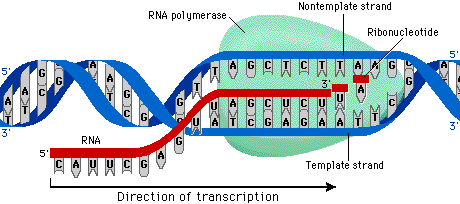
The gen with the information for the protein is located in the DNA inside the nucleus, that cannot leave it. So the solution is to produce a new molecule, called RNA-MESSENGER or RNAm, that can do it. For that, there is a new enzyme, the RNA-POLYMERASE, which goes reading the nucleotides in the gene and creates a complementary strand, but instead of being of DNA is of RNA. How can we know that? Easy, in the DNA we have 4 bases: A, G, C and T. In the RNA there are also 4 bases: A, G, C and U (uracil) instead of T (thymine doesn´t exist in RNA). When the strand is transcribed, it leaves the nucleus through the nuclear pores.

El gen con la información para la proteína está localizada en el ADN dentro del núcleo, que no puede dejarlo. Así que la solución es producir una nueva molécula llamada ARN-MESNAJERO o ARNm, que puede hacerlo. Para ello, hay una nueva enzima, la ARN-POLIMERASA, que va leyendo los nucleótidos en el gen y crea una hebra complementaria, pero en vez de ser de ADN es de ARN. ¿Cómo podemos saber eso? Fácil, en el DNA tenemos 4 bases: A, G, C y T. En el ARN también hay 4 bases: A, G, C y U (uracilo) en vez de T (la timina no existe en el RNA). Cuando la hebra es transcrita, deja el núcleo a través de los poros del núcleo.


* DIFFERENCES BETWEEN DNA AND RNA (DIFERENCIAS ENTRE ADN Y ARN)


Review exercise: DNA vs RNA


domingo, 24 de enero de 2016

DNA REPLICATION (REPLICACIÓN DEL ADN)


When cells reproduce (because we are growing, or we have to repair tissues), before the mitosis the DNA has to be duplicated. This happens during the S phase of the cell cycle, and the duplication or replication of the DNA is called SEMICONSERVATIVE: it means that from one double helix we obtain two double-helix, each one with a new strand and one of the old strands.

Cuando las células se reproducen (porque estamos creciendo, o tenemos que reparar tejidos), antes de que ocurra la mitosis el ADN tiene que ser duplicado. Esto ocurre durante la fase S del ciclo celular, y la duplicación o replicación del ADN se llama SEMICONSERVATIVA: significa que desde un doble hélice vamos a obtener dos dobles hélices, cada una formada por una hebra nueva y una de las hebras viejas.


The steps for replication are:
1. The DNA molecule is unzipped by the enzyme helicase.
2. The point where the DNA opens is called replication fork.
3. Another enzyme, the DNA-polymerase, goes reading the bases sequence in a strand, creating a complementary strand.
4. Both strands get a new complementary one, one directly, the other goes in opposite direction, so the DNA polymerase goes creating little fragments (Okazaki fragments). Then a ligase enzyme will bond them.
In eukaryotes there are several points opening at the same time, so the replication takes place faster.


Los pasos para la replicación son:
1. La molécula de ADN es abierta por la enzima helicasa.
2. El punto donde el ADN se abre se llama horquilla de replicación.
3. Otra enzima, la ADN-polimerasa, va leyendo la secuencia de bases es una hebra, creando una hebra complementaria.
4. Ambas hebras consiguen una hebra complementaria, una directamente, la otra va en dirección contraria, así que la ADN polimerasa va creando pequeños frgmentos (fragmentos de Okzaki). Luego un enzima ligasa los unirá.
En eucariotas hay varios puntos abiréndose a la vez, para que la replicación vaya más rápida.


Reviewing exercise: REPLICATION