domingo, 27 de marzo de 2016

DOMAINS AND KINGDOMS (DOMINIOS Y REINOS)

The top and biggest level in the classification system is the DOMAIN, where we only find three different divisions:

El más alto y mayor nivel en el sistema de clasificación es el DOMINIO, donde solo encontramos tres divisiones:


* ARCHAEA DOMAIN: "antique" organisms, they are supposed to be the first organisms appeared on Earth. They have some basic characteristics: unicellular, prokaryote, autotrophs or heterotrophs, with asexual reproduction. The most important and the different with the other bacteria is that they live in extreme environments (very hot, very cold, or without oxygen). It includes just one Kingdom, the Archaea Kingdom.

  DOMINIO ARCHAEA: organismos "antiguos" se suponen que fueron los primeros organismos que aparecieron en la Tierra. Tienen ciertas características básicas: unicelulares, procariotas, autótrofas o heterótrofas, con reproducción asexual. Lo mas importante y la diferencia con las otras bacterias es que viven en ambientes extremos (muy calientes, muy fríos, o si oxigeno). Solo incluye un reino, el Reino Archaea.


* BACTERIA DOMAIN: with the same basic characteristics as the archaea, but they are bacteria living with us (in our environments, inside us, in our skin). They are also the bacteria that produce diseases in humans. It only includes a kingdom, the Bacteria (or Eubacteria) Kingdom.

  DOMINIO BACTERIA: con las mismas características que los archaea, pero son bacterias que viven con nosotros (en nuestros ambientes, dentro de nosotros, en nuestra piel). También son las bacterias que producen enfermedades en los humanos. Solo incluyen un reino, el Reino Bacteria (o Eubacteria).


* EUKARYA DOMAIN: all the eukaryote organisms. It includes the other four kingdoms: Animal, Plant, Fungi and Protista Kingdoms.

 DOMINIO EUKARYA: todos los organismos eucariotas. Incluye los otros cuatro reinos: Animal, Vegetal, Hongos y Protistas.


sábado, 19 de marzo de 2016

CLASSIFICATION AND TAXONOMY (CLASIFICACIÓN Y TAXONOMÍA)


1- WHY DO WE CLASSIFY?

Dog, perro, gos, cane, chien...if we need to talk with someone about an organism, for example a dog, what happens if we don't share the same language? Or maybe we share it, but depending on the area where we live it has different names, like the case of  dog in Spain: perro, can, gos, txacur...And we are talking about the same organism! That´s why organisms have a scientific name, a specific name made up of two words, the specific name and the genus name. For the dog, the scientific name is Canis lupus familiaris:


This type of nomenclature was established by Carl Linnaeus, and it is called the BINOMIAL NOMENCLATURE: The first word, always beginning with capital letter, is the genus, common to other organisms like wolves and jackals (Canis simensis). The second one is the species, always in lower case letter, only organisms that can interbreed share the same species. The third one is not always present, is the subspecies, in this case to differentiate dogs and wolves (Canis lupus lupus)...and yes, they are the same species, they reproduce and have fertile offspring!

But this is not the only level, we have eight levels of classification as I show you in the next diagram:


DOMAIN (Eukarya = eukaryote cells) , KINGDOM (Animal), PHYLUM (Chordata = with spine), CLASS (Mammalia) , ORDER (Carnivora), FAMILY (Canidae), GENUS (Canis), SPECIES (lupus), SUBSPECIES (familiaris).

How can we remember this?  DEAR KING PHILLIP CAME OVER FOR GREAT SOUP.


1- ¿POR QUÉ CLASIFICAMOS?

Dog, perro, gos, cane, chien... si necesitamos hablar con alguien sobre algún organismo, por ejemplo un perro, ¿qué ocurre si no compartimos la misma lengua? O quizás la compartimos, pero dependiendo del áera donde vivimos tiene nombres diferentes, como el caso del perro en España: perro, can, gos, txacur...Y estamos hablando del mismo organismo! Por eso los organismos tienen un nombre científico, un nombre específico hecho de dos palabras, el nombre específico y el género. Para el perro, el nombre científico es Canis lupus familiaris:


Este tipo de nomenclatura fue establecida por Carl Linnaeus, y se llama la NOMENCLATURA BINOMIAL: La primera palabra, siempre empezando en mayúscula, es el género, común a otros organismos como los lobos o los chacales (Canis simensis). La segunda palabra es el nombre específico, siempre en minúscula, solo los organismos que pueden reproducirse comparten la misma especie. La tercera palabra no siempre está presente, es la subespecie, en este caso para diferenciar perros de lobos (Canis lupus lupus)...y sí, son de la misma especie, pueden reproducirse y tener descendencia fértil!

Pero este no es el único nivel de clasificación, tenemos ocho como os muestro a continuación:


DOMINIO (Eukarya = células eucariotas) , REINO (Animal), PHYLUM (Cordados = con espina dorsal), CLASE (Mamíferos) , ORDEN (Carnívoros), FAMILIA (Cánidos), GÉNERO (Canis), ESPECIE (lupus), SUBESPECIE (familiaris).

¿Cómo podemos recordarlo?  DEAR KING PHILLIP CAME OVER FOR GREAT SOUP.

martes, 8 de marzo de 2016

lunes, 29 de febrero de 2016

PLATE TECTONIC EVOLUTION (EVOLUCION DE LA TECTÓNICA DE PLACAS)

I want to share this video with you...amazing!!!

Quiero compartir este video con vosotros...impresionante!!!


domingo, 21 de febrero de 2016

EVOLUTION PART II: MECHANISMS OF EVOLUTION (Evolución parte II: Mecanismos de la Evolucion)

Basically we have four types of mechanisms in Evolution:
- Natural Selection.
- Gene flow.
- Genetic drift.
- Mutations.


1) NATURAL SELECTION (SELECCIÓN NATURAL)

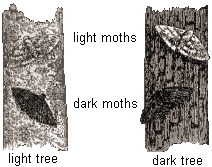
Described by Darwin, basically it says that the environment is the one changing (not the organisms), and it is the nature the one that "selects" the best organisms. The steps could be summarized as:

1. Inside populations there is variability, not all the organisms are the same.

2. For a certain environment, some organisms will be best adapted, having advantage, surviving more  and reproducing.

3. They will pass their successful characteristics to their offspring.

4. These characteristics  will become more frequent in the population.


This is described as the "survival of the fittest". But the environment changes, and the best adapted in a moment could not be the fittest in other moment.

Descrito por Darwin, básicamente dice que es el ambiente el que cambia (no los organismos), y es la naturaleza la que selecciona a los mejores organismos. Los pasos se podrían resumir:

1. Dentro de las poblaciones hay variedad, no todos los organismos son iguales.

2. Para cierto ambiente, algunos organismos estarán mejor adaptados, teniendo ventaja, sobreviviendo y reproduciendose mas.

3. Estos pasaran sus características exitosas a su descendencia.

4. Estas características se harán mas frecuentes en la población.

Esto se describe como la "supervivencia de los mas aptos". Pero el ambiente cambia, y los mejores adaptados en un momento pueden no ser los mejores adaptados en otro momento.


2) GENE FLOW  (FLUJO DE GENES)

It can be summarized as in one stable population new organisms arrive with new characteristics, these characteristics will appear in next generations, changing the percentages of the characteristics.

Puede resumirse como que si en una población estable llegan nuevos organismos con nuevas características, estas características aparecerán en las nuevas generaciones, cambiando los porcentajes de las características.


3) GENETIC DRIFT  (DERIVA GENETICA)

When a population is affected by an event totally by chance, so the percentages of the characteristics in the populations are going to change. There are two important types of genetic drift events: the Founder Effect and the Bottleneck Effect.

Cuando una población es afectada por un evento totalmente al azar, los porcentajes de las características en la población van a variar. Hay dos tipos importantes de eventos de deriva genética: el Efecto Fundador y el Efecto Cuello de Botella.


     a) FOUNDER EFFECT  (EFECTO FUNDADOR)

      When a population isolates from others creating a new colony, the new population will be small, so it will have less genetic variation. Some characteristics that in the first population were common could even disappear, or recessive traits in the main population could become frequent in the colony. For example, the six fingers in the Amish population.

Cuando una población se aísla de otras creando una nueva colonia, la nueva población será pequeña,por lo que tendrá menos variación genética. Algunas características que en la primera población eran comunes podrían incluso desaparecer, o rasgos recesivos en la población principal podrían volverse frecuentes en la colonia. Por ejemplo, los seis dedos en la población Amish. 


     b) BOTTLENECK EFFECT  (EFECTO CUELLO DE BOTELLA)

    In this case a population decreases (sometimes even near to extinction) due to a random event (hunting, natural disaster...). The population survives with a few individuals, so the variety of genetic variation is low. When the population increases in time, it has lost characteristics which it usually had before the disaster. For example, what happened with sea elephants due to their hunting by human.

    En este caso una población disminuye (a veces incluso cerca de la extinción) debido a un suceso al azar (caza, desastre natural...). La población sobrevive con unos pocos individuos, así que la variedad genética es baja. CUando la población se recupera en el tiempo, ha perdido características que solía tener antes del desastre. Por ejemplo, lo que les ocurrió a los elefantes marinos debido a su caza por los humanos.


4) MUTATIONS   (MUTACIONES)

Mutations are changes in the DNA. When these mutations affect gametes (sperm and egg cells) and can pass to the offspring, is when they can affect evolution. ANd not always, because we have neutral mutations, positive mutations and negative mutations, and all of them happen randomly.

Las mutaciones son cambios en el DNA. Cuando estas mutaciones afectan a los gametos (espermatozoides y óvulos) y pueden pasar a la descendencia es cuando pueden afectar a la evolución. Y no siempre, porque hay mutaciones neutras, mutaciones positivas y mutaciones negativas, y todas ellas ocurren al azar.


miércoles, 17 de febrero de 2016

EVOLUTION PART 1: EVIDENCES OF EVOLUTION. (Evolución parte 1: Pruebas de la Evolución)

The Theory of Evolution is, as its name says, a theory based on different data and evidences that support it. Evolution means "change", so this theory talks about how organisms go changing through time. In this part we are going to talk about the evidences of evolution:

La Teoría de la Evolución es, como su nombre indica, una teoría basada en diferentes datos y pruebas que la apoyan. Evolución significa "cambio", así esta teoría nos habla sobre cómo los organismos cambian a través del tiempo. En esta parte vamos a hablar de las pruebas de la evolución:

1) FOSSIL RECORD  (REGISTRO FÓSIL)

Fossils are the remains of organisms that lived in other eras. They can be bones, shells, prints in rocks...as you see, rests of organisms that don't decompose. They give us information about ancient organisms, the eras when they existed, most of them are extinct, others are related with today existing forms and show us how they have been evolving, and sometimes we find transitional fossils like Tiktaalik.

Los fósiles son restos de organismos que vivieron en otras eras. Pueden ser huesos, conchas, marcas en las rocas...como veis, restos de organismos que no se descomponen. Nos dan información sobre organismos antiguos, las épocas cuando existieron, la mayoría de ellos extintos, otros están relacionados con formas que existen actualmente y nos muestran cómo han ido evolucionando, y a veces encontramos fósiles transicionales como Tiktaalik.


2) BIOGEOGRAPHY  (BIOGEOGRAFÍA)

Biogeography is the science that studies the distribution of organisms on Earth. Studying how they are distributed nowadays and going back in time, we can find out that species far apart today come from a common ancestor in the Pangea era.

La Biogeografía es la ciencia que estudia la distribución de los organismos en la Tierra. Estudiando cómo se distribuyen actualmente y yendo atrás en el tiempo, podemos averiguar qué especies apartadas en la actualidad vienen de un antecesor común en la era de Pangea.


3) ANATOMICAL  (ANATÓMICAS)

When comparing the anatomy of organisms, we can see HOMOLOGOUS STRUCTURES, like the arm of a man, the limb of a cat, the wing of a bat and the fin of a whale: they have different functions, but inside they have the same skeletal structure: one bone-two bones- little bones - digits, so these structures come from a common ancestor, and they have evolved differently due to a DIVERGENT EVOLUTION.

Cuando comparamos la anatomía de organismos, podemos ver ESTRUCTURAS HOMÓLOGAS, como el brazo de un hombre, la pata de un gato, el ala de un murciélago y la aleta de una ballena: tienen diferentes funciones, pero por dentro tienen la misma estructura esquelética: un hueso-dos huesos- huesos pequeños-digitos, asi que estas estructuras proceden de un antecesor común, y han evolucionado de forma diferente por EVOLUCIÓN DIVERGENTE.


On the other hand we have structures with similar functions but not related by an ancestor, as the wings of an insect and the wings of a bird, with similar function due to CONVERGENT EVOLUTION. These are called ANALOGOUS STRUCTURES.

Por otra parte tenemos estructuras con funciones similares pero no relacionadas por un antepasado, como las alas de un insecto y as de un pajara, con funciones similares debido a EVOLUCIÓN CONVERGENTE. A estas se les llaman ESTRUCTURAS ANÁLOGAS.


4) EMBRYOLOGICAL  (EMBRIOLOGÍA)

When we compare embryos from different organisms there are similarities during the first steps of development, like the presence of gills or tails in different types of animals, although later on they don't develop. This is another evidence of the existence of a common ancestor between them.

Cuando comparamos embriones de distintos organismos hay similitudes durante los primeros pasos del desarrollo, como la presencia de hendiduras branquiales o colas en diferentes tipos de animales, aunque después no se desarrollan. Esta es otra evidencia de la existencia de un antecesor común entre ellos.


5) VESTIGIAL ORGANS  (ÓRGANOS VESTIGIALES)

Vestigial organs are organs in organisms without a function, being an evidence of a previous function during the past, so an evidence of changes in organisms. For example, the appendix or the goosebumps in humans,

Los órganos vestigiales son órganos en organismos sin ninguna función, siendo una prueba de una anterior función en el pasado, por ello una evidencia de cambios en los organismos. Por ejemplo, el apéndice o la piel de gallina en los humanos.


6) MOLECULAR

The best way to know the relationship between certain organisms is comparing their DNA sequences, or the presence or absence of certain proteins (amino acid chains). The most similarities they have, the more closer they are related. For example, human and chimpanzee share 98% of their DNA.

La mejor manera de saber la relación entre ciertos organismos es comparando sus secuencias de DNA, o la presencia o ausencia de ciertas proteínas (cadenas de aminoácidos). A mayor numero de similitudes, más relacionados están. Por ejemplo, los humanos y los chimpancés comparten el 98% de su DNA.


domingo, 14 de febrero de 2016

BUTTERFLY GARDEN!!!

At last....we have begun creating our own butterfly garden at Southwest!!! Hoping it grows so we can see Monarch butterflies and as many species as we can!